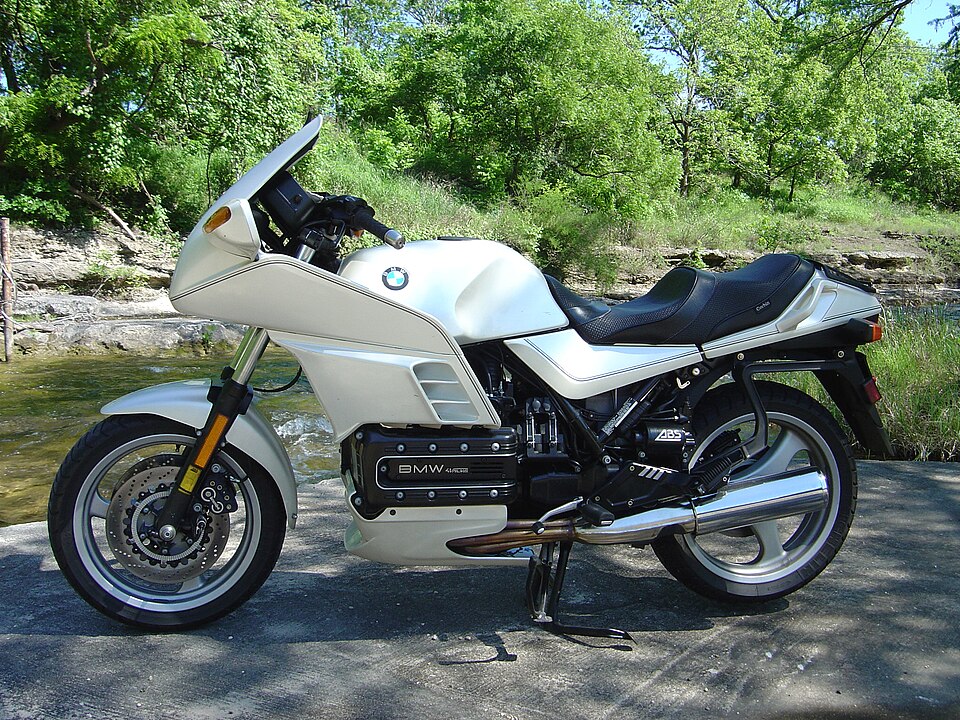
K100 — The Flying Brick

The original K100 launched in 1983 and established BMW's K-Series platform. Its longitudinal inline-four engine — mounted sideways so cylinders lay flat — was unlike anything else in production motorcycling. The nickname "Flying Brick" captured its shape exactly.

Why Mount It Sideways?

The genius of the K100's layout is its low centre of gravity. A conventional upright inline-four sits high — the crankshaft, cylinders, and head stack vertically, raising the bike's mass. BMW's engineers turned it 90 degrees: the crankshaft now runs front-to-back along the bike's centreline, with the cylinders lying parallel to the ground.

The result is mass concentrated below the rider's knees. Combined with shaft drive (no chain to maintain) and electronic fuel injection (a first for BMW Motorrad), the K100 was technologically five years ahead of most competitors.

The Monolever rear suspension — a single-sided swingarm with one central shock — kept the drivetrain clean and allowed easy rear wheel removal. Its aesthetic was controversial at launch; today it looks prescient.
ConfigurationInline-4, longitudinal
Displacement987 cc
Bore × Stroke67 mm × 70 mm
Compression Ratio10.2:1
Peak Power90 hp @ 8,000 rpm
Peak Torque96 Nm @ 6,000 rpm
CoolingWater-cooled
FuellingBosch Motronic EFI (first for BMW)
Gearbox5-speed
Final DriveCardan shaft
Rear SuspensionBMW Monolever single-arm
Wet Weight232 kg
BMW K100
K100
Germany · 1983
BMW K100 — Standard
The original Flying Brick — naked sports tourer
🏗️The base K100 wore minimal bodywork to show off the unusual longitudinal engine layout. BMW knew riders would need to see the engine to understand why the layout was so different — and so superior for mass centralisation.
Electronic fuel injection in 1983 was genuinely exotic on a motorcycle. The Bosch Motronic system — the same as used in BMW's cars — gave the K100 consistent cold-start reliability and throttle response that carburetted competitors couldn't match.
🌡️Water cooling allowed tighter engine tolerances and lower emissions than the boxer's air-cooled cylinders. BMW wanted to future-proof the K-Series against tightening regulations — a prudent decision that kept the platform viable through the 1990s.
BMW K100RS
K100RS
Germany · 1983
BMW K100RS — Sport Fairing
The fastest practical tourer of its era
💨The K100RS added a full sport fairing designed in BMW's wind tunnel — the same facility used for their racing cars. Wind protection was outstanding for a 1983 motorcycle, allowing sustained high-speed cruising with minimal fatigue.
🏆Motorcycle journalists consistently named the K100RS the best all-round motorcycle available in the mid-1980s. It could exceed 200 km/h while carrying two riders and luggage — a combination no competitor matched at the price point.
🛡️The K100RS was the first BMW Motorrad to be optionally fitted with ABS — a technology so new in the early 1990s that many dealers didn't know how to service it. BMW trained mechanics specifically for the system.