BMW Motorrad · 1983–Present

BMW K-Series

The Flying Brick dynasty — from 987cc bricks to 1649cc six-cylinder masterpieces.
40+
Years
167 hp
K1200S Peak
160 hp
K1600 GT/GTL
85k+
K100s Sold
1649cc
K1600 Inline-6
BMW K100 — The Flying Brick
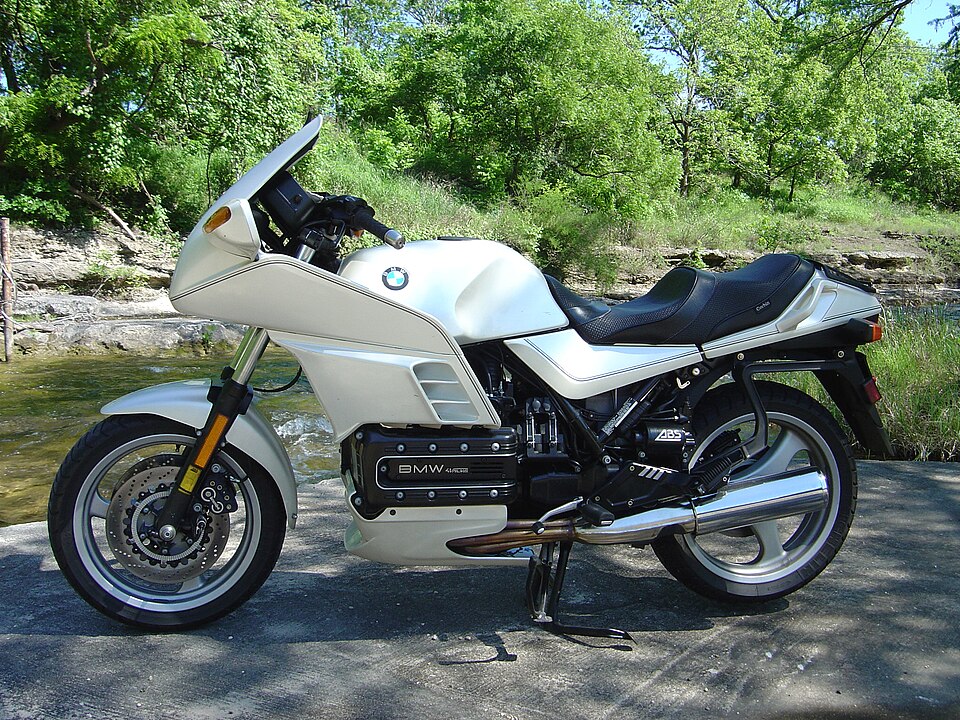
BMW K100 (1983) — the "Flying Brick" that launched four decades of K-Series innovation
History

The K-Series began as an act of courage. In 1983, BMW broke entirely from its boxer tradition and mounted an inline-four on its side — creating the "Flying Brick" that would carry BMW Motorrad into the modern era. Four decades later, the K-Series has grown from 987cc to a silky 1649cc inline-six that is unlike anything else in production motorcycling.

1978
Genesis
Project 2000 — The K-Series is Conceived
BMW Motorrad looks beyond the boxer

BMW Motorrad engineers began Project 2000 — a secret development programme to build a fundamentally different motorcycle. The brief: modern emissions compliance, superior performance, and a completely new engine architecture. The boxer twin was beloved but its limitations were real: the wide cylinder heads limited cornering clearance and the air-cooling system was increasingly challenged by emissions regulations.

Project 2000New Architecture Emissions FocusPerformance Target
1983
The Flying Brick Arrives
BMW K100 — Production Launch
The most radical BMW motorcycle in 60 years

The K100 arrived at the Cologne Motor Show in September 1983 — and stunned everyone. An inline-four cylinder engine mounted longitudinally, lying on its side with the cylinders parallel to the ground. The crankshaft ran front-to-back along the centreline. The result: the lowest possible centre of gravity for an inline-four, excellent weight distribution, and a compact chassis. 90 hp, electronic fuel injection (a first for BMW Motorrad), and shaft drive. The press called it "the Flying Brick" — the name stuck.

987cc Inline-4Longitudinal Layout First EFI BMW90 hp Shaft Drive
1985
K75 Arrives
BMW K75 — The Three-Cylinder Brick
75% of the K100 becomes an entirely different machine

BMW's modular K-platform produced the K75 — a 740cc three-cylinder using three-quarters of the K100 engine block with the fourth cylinder eliminated. The K75 was lighter (215 kg wet), more agile, and beloved by urban riders who found the K100 too large. The K75S with full fairing developed a devoted following, particularly in Europe. Over 40,000 K75s were sold — validating the platform's versatility.

740cc Triple215 kg Wet K75 / K75S / K75RT40,000+ Sold
1988
Performance Escalation
BMW K1 — The Aerodynamic Brick
100 hp, full fairing, the fastest BMW ever built to that date

The K1 arrived as BMW's most radical production motorcycle — a fully enclosed, aerodynamically optimised sportbike built on the K100 platform. Its 987cc engine was tuned to 100 hp and wrapped in bodywork designed by BMW's car division. The K1 achieved a drag coefficient of 0.36 Cd — extraordinary for a motorcycle of that era. Its yellow/red colour scheme became instantly iconic. Only 6,921 were built, making it a sought-after collectors' machine today.

100 hp0.36 Cd Full Enclosure6,921 Built Collectors' Item
1994
First ABS
K-Series Leads Safety Technology
BMW pioneers anti-lock braking on production motorcycles

BMW Motorrad was among the first manufacturers to offer ABS (Anti-Lock Braking System) as standard on production motorcycles — initially on the K100 and K75 ranges. This decision, made against industry convention that viewed ABS as unnecessary weight and complexity, proved visionary. ABS is now mandatory in most markets. BMW's leadership in motorcycle safety technology traces directly to the K-Series programme of the late 1980s and early 1990s.

First Moto ABSSafety Pioneer Now Mandatory EUIndustry-Leading
2004
K1200 Generation
BMW K1200S — 167 hp Sports Tourer
The fastest production BMW motorcycle ever built

The K1200S launched with a 1157cc longitudinal inline-four producing 167 hp — making it the most powerful production BMW motorcycle at the time and one of the most powerful sports tourers in the world. Its Duolever front suspension — a double-wishbone arrangement replacing conventional telescopic forks — eliminated fork dive under braking entirely. Top speed exceeded 280 km/h. The K1200 family expanded to include the K1200R (naked), K1200GT (tourer), and K1200RS (sport-tourer).

1157cc167 hp 280+ km/hDuolever Front K1200S/R/GT/RS
2009
K1300 Generation
BMW K1300S — The Refined Brick
1293cc, 175 hp, electronic suspension

The K1200 evolved into the K1300S with a larger 1293cc engine producing 175 hp and an expanded electronics package including optional ESA (Electronic Suspension Adjustment) — the first semi-active suspension offered on a BMW sports tourer. The K1300R naked and K1300GT tourer completed the family, each offering class-leading power in their segments. The K1300S remained competitive with dedicated superbikes while carrying genuine touring capability.

1293cc175 hp ESA SuspensionK1300S/R/GT
2011
The Six-Cylinder Arrives
BMW K1600GT / GTL — The Inline-Six
The only production inline-six motorcycle in the world

BMW shocked the industry again in 2011 with the K1600GT — powered by a 1649cc inline-six engine producing 160 hp and 175 Nm of torque. The six-cylinder layout was chosen for smoothness: a perfectly balanced configuration that runs with zero first and second-order vibrations. At idle, the K1600 engine is so smooth that the tachometer needle barely moves. The GTL (Grand Tour Luxe) added integrated hard luggage, a full fairing with integrated LED lighting, and the highest seat height in the range. No other manufacturer has matched the K1600's six-cylinder configuration to this day.

1649cc Inline-6160 hp 175 NmZero Vibration Only Moto Inline-6
2017
K1600 Expansion
K1600B and K1600 Grand America
BMW enters the American bagger and touring segments

BMW extended the K1600 platform to target the American touring market with the K1600B (bagger) and K1600 Grand America (premium tourer). The K1600B features a lower seat height, integrated panniers, and a forward-leaning bagger stance. The Grand America adds cruise control, heated seat, Adaptive Headlight, and — exclusively — a reverse gear driven by the starter motor, a first for a BMW motorcycle.

K1600B BaggerGrand America Reverse GearAdaptive Headlight
K100 — The Flying Brick

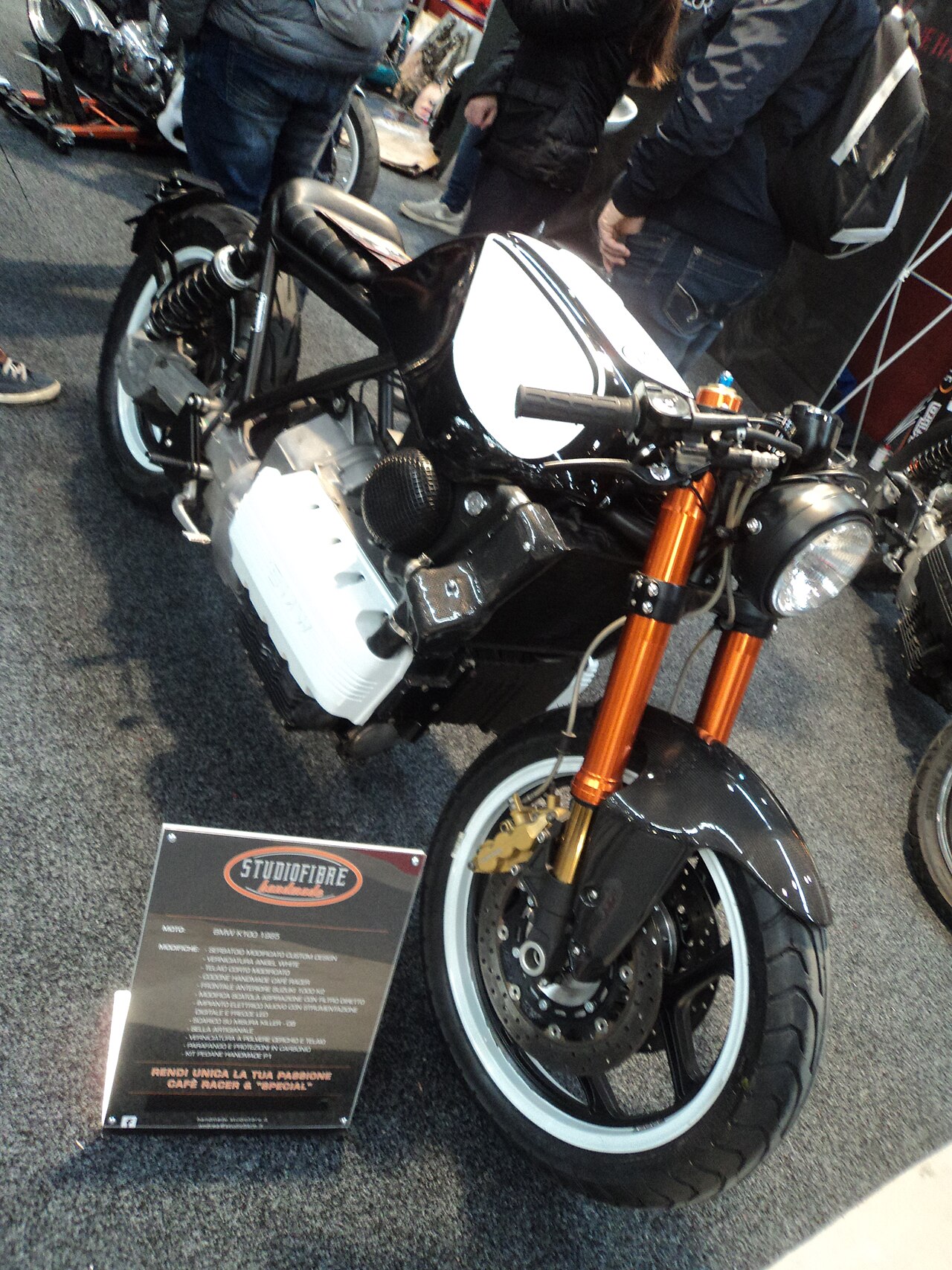
The original K100 launched in 1983 and established BMW's K-Series platform. Its longitudinal inline-four engine — mounted sideways so cylinders lay flat — was unlike anything else in production motorcycling. The nickname "Flying Brick" captured its shape exactly.

Why Mount It Sideways?

The genius of the K100's layout is its low centre of gravity. A conventional upright inline-four sits high — the crankshaft, cylinders, and head stack vertically, raising the bike's mass. BMW's engineers turned it 90 degrees: the crankshaft now runs front-to-back along the bike's centreline, with the cylinders lying parallel to the ground.

The result is mass concentrated below the rider's knees. Combined with shaft drive (no chain to maintain) and electronic fuel injection (a first for BMW Motorrad), the K100 was technologically five years ahead of most competitors.

The Monolever rear suspension — a single-sided swingarm with one central shock — kept the drivetrain clean and allowed easy rear wheel removal. Its aesthetic was controversial at launch; today it looks prescient.
ConfigurationInline-4, longitudinal
Displacement987 cc
Bore × Stroke67 mm × 70 mm
Compression Ratio10.2:1
Peak Power90 hp @ 8,000 rpm
Peak Torque96 Nm @ 6,000 rpm
CoolingWater-cooled
FuellingBosch Motronic EFI (first for BMW)
Gearbox5-speed
Final DriveCardan shaft
Rear SuspensionBMW Monolever single-arm
Wet Weight232 kg
BMW K100
K100
Germany · 1983
BMW K100 — Standard
The original Flying Brick — naked sports tourer
🏗️The base K100 wore minimal bodywork to show off the unusual longitudinal engine layout. BMW knew riders would need to see the engine to understand why the layout was so different — and so superior for mass centralisation.
Electronic fuel injection in 1983 was genuinely exotic on a motorcycle. The Bosch Motronic system — the same as used in BMW's cars — gave the K100 consistent cold-start reliability and throttle response that carburetted competitors couldn't match.
🌡️Water cooling allowed tighter engine tolerances and lower emissions than the boxer's air-cooled cylinders. BMW wanted to future-proof the K-Series against tightening regulations — a prudent decision that kept the platform viable through the 1990s.
BMW K100RS
K100RS
Germany · 1983
BMW K100RS — Sport Fairing
The fastest practical tourer of its era
💨The K100RS added a full sport fairing designed in BMW's wind tunnel — the same facility used for their racing cars. Wind protection was outstanding for a 1983 motorcycle, allowing sustained high-speed cruising with minimal fatigue.
🏆Motorcycle journalists consistently named the K100RS the best all-round motorcycle available in the mid-1980s. It could exceed 200 km/h while carrying two riders and luggage — a combination no competitor matched at the price point.
🛡️The K100RS was the first BMW Motorrad to be optionally fitted with ABS — a technology so new in the early 1990s that many dealers didn't know how to service it. BMW trained mechanics specifically for the system.
K1200 Family — The Peak of the Brick

The K1200 generation (2004–2009) represented the highest evolution of the longitudinal inline-four concept. 167 hp, Duolever front suspension, 280+ km/h top speed — and a full family of S, R, GT, and RS variants.

The Duolever Front End

Conventional telescopic forks compress under braking — the front of the bike dives, the geometry changes, and the rider experiences pitch. BMW's Duolever system eliminates this entirely.

Two wishbones (upper and lower) connect the front wheel hub to the frame through a central pivot. A separate damper unit manages suspension movement. The geometry remains constant under braking — exactly as on a double-wishbone car suspension.

The result: under maximum braking from 280 km/h, the K1200S maintains its riding position. The rider can brake later and harder with more confidence, because the bike doesn't pitch forward. Steering feel remains consistent from full acceleration to emergency braking.

No other production motorcycle manufacturer has adopted this system — it remains uniquely BMW.

ConfigurationInline-4, longitudinal
Displacement1,157 cc
Bore × Stroke70.5 mm × 74 mm
Compression Ratio13.0:1
Peak Power (K1200S)167 hp @ 10,250 rpm
Peak Torque130 Nm @ 8,250 rpm
Top Speed (K1200S)280+ km/h
Front SuspensionBMW Duolever (double wishbone)
Rear SuspensionBMW Paralever EVO
Gearbox6-speed
Wet Weight (K1200S)234 kg
FamilyS · R · GT · RS
BMW K1200S
K1200S
Germany · 2004
BMW K1200S
The sports tourer that could embarrass a superbike
Power
167 hp
Torque
130 Nm
Top Speed
280+ km/h
Weight
234 kg
With 167 hp and 130 Nm of torque, the K1200S out-accelerated most dedicated superbikes while offering full weather protection and luggage capacity. Road testers consistently described riding it as "operating an aircraft."
🔩The Duolever front suspension made 280 km/h braking feel stable and predictable — an extraordinary achievement for a 234 kg motorcycle. BMW offered optional ESA (Electronic Suspension Adjustment) so riders could tune damping from the handlebars.
BMW K1200R
K1200R
Germany · 2005
BMW K1200R
The Flying Brick stripped bare — naked power
Power
163 hp
Style
Naked / Roadster
Weight
228 kg
Seat
820 mm
🏍️The K1200R took the K1200S engine and removed all bodywork — creating a 163 hp naked roadster. Unfaired at those speeds, the K1200R rewarded experienced riders who knew how to manage its power. It became a cult machine among those who considered it too much motorcycle for most.
🎨BMW added a small windscreen and headlight fairing for the K1200R Sport variant — enough to civilise high-speed exposure slightly while maintaining the aggressive, stripped aesthetic that differentiated it from the full-faired S.
BMW K1200GT
K1200GT
Germany · 2006
BMW K1200GT
Grand touring with 167 hp on tap
Style
Grand Tourer
Luggage
Integrated
Windscreen
Adjustable electric
Heated
Grips standard
🌍The K1200GT took the same 167 hp engine and wrapped it in full touring bodywork with integrated hard panniers, electric windscreen adjustment, and heated grips — making it possibly the most practical high-performance tourer ever built.
🛣️On a motorway, the K1200GT could cover 500 km between fuel stops while cruising at 200 km/h with its rider arriving less fatigued than on a sports tourer. It was the business traveller's motorcycle — fast enough to embarrass superbikes, practical enough to commute.
BMW K1300S
K1300S
Germany · 2009
BMW K1300S
175 hp — the ultimate evolution of the brick engine
Displacement
1,293 cc
Power
175 hp
Torque
140 Nm
ESA
Optional
📡The K1300S added optional Electronic Suspension Adjustment (ESA) — the rider could switch between Comfort, Normal, and Sport damping settings via a handlebar button. At 280 km/h, adjusting suspension while riding required confidence the system was genuinely responsive.
🏁With 175 hp and 140 Nm from 1,293cc, the K1300S was quicker than many dedicated superbikes in real-world conditions. Its power-to-weight ratio was comparable to a Ducati 1198 — while carrying heated grips and luggage mounts.
K1600 — The Inline-Six

In 2011, BMW added a sixth cylinder. The 1649cc inline-six in the K1600 is the only production motorcycle six-cylinder engine in the world. It produces 160 hp with a silky smoothness that no other engine configuration can match — and no other manufacturer has attempted to replicate it.

Why Six Cylinders?

A straight-six engine achieves what engineers call perfect primary and secondary balance — the firing pulses cancel each other out so completely that the engine produces virtually no vibration at any rpm. This is the same reason Rolls-Royce, Jaguar, and BMW's own cars use straight-six engines for their flagship models.

On a motorcycle, this means that at idle, the K1600's engine is so smooth that a cup of water placed on the tank barely ripples. At motorway speeds, the vibration reaching the rider through the handlebars and seat is less than most four-cylinder motorcycles.

The 1649cc displacement was chosen to give each cylinder a manageable 275cc — similar to a Honda CB500 cylinder — keeping combustion temperatures and component stresses reasonable while the overall displacement delivers effortless highway torque.

BMW packaged this 1649cc inline-six into the same physical width as a 1000cc inline-four from a rival manufacturer — an engineering achievement that required custom manufacturing processes for the cylinder block.

ConfigurationInline-6, longitudinal
Displacement1,649 cc
Bore × Stroke72 mm × 67.5 mm
Compression Ratio12.2:1
Peak Power160 hp @ 7,750 rpm
Peak Torque175 Nm @ 5,250 rpm
VibrationNear zero (perfect balance)
Gearbox6-speed + optional reverse
Final DriveCardan shaft
Wet Weight (GT)348 kg
Unique FeatureOnly production moto inline-6
FamilyGT · GTL · B · Grand America
BMW K1600GT
K1600GT
Germany · 2011
BMW K1600GT
Sport tourer with a six-cylinder engine unlike anything else
🎵The K1600GT's exhaust note is unlike any other motorcycle — six cylinders firing smoothly create a deep, mechanical harmony rather than a sharp bark. At high revs it approaches the sound of a racing straight-six car engine.
🌡️Despite 160 hp, the K1600GT runs cooler than many high-performance motorcycles because the power is spread across six smaller combustion chambers. Each cylinder contributes 27 hp — less thermal stress than a highly-strung four-cylinder at similar output.
📐BMW engineered the six-cylinder engine to be no wider than their competitors' four-cylinder engines — a packaging feat that required custom casting techniques. The K1600 is narrower at the fairing than many large-displacement tourers.
BMW K1600 Grand America
GRAND AMERICA
Germany · 2017
BMW K1600 Grand America
The most equipped touring motorcycle BMW has ever made
🔄The K1600 Grand America is the only BMW motorcycle to offer a reverse gear — driven by the starter motor. At 348 kg, reverse is not a luxury but a necessity for many parking situations. BMW engineers the starter motor to handle the load.
💡The Adaptive Headlight turns as the motorcycle leans in corners — a technology borrowed from BMW's car division. On dark mountain roads, the headlight illuminates the apex of a corner, not just straight ahead, improving night riding safety significantly.
📡Standard equipment includes cruise control, heated seat and grips, electronic windscreen, keyless ignition, and a 10.25-inch TFT display with navigation, phone integration, and tyre pressure monitoring — the most comprehensively equipped touring motorcycle in production.
K-Series Model Comparison

From the 1983 K100 to the current K1600 Grand America — four decades of evolution in one table.

Specification
K100 (1983)
K1200S (2004)
K1300S (2009)
K1600GT (2011)
K1600 G·A (2017)
Engine
987cc I4
1157cc I4
1293cc I4
1649cc I6
1649cc I6
Peak Power
90 hp
167 hp
175 hp
160 hp
160 hp
Peak Torque
96 Nm
130 Nm
140 Nm
175 Nm
175 Nm
Top Speed
~210 km/h
280+ km/h
280+ km/h
250 km/h
250 km/h
Wet Weight
232 kg
234 kg
234 kg
348 kg
350 kg
Front Suspension
Tele forks
Duolever
Duolever
Tele forks
Tele forks
ABS
Optional (later)
Standard
Standard
Standard
Standard
Gearbox
5-speed
6-speed
6-speed
6-speed
6-spd + Rev